Imagine the same day aboard two very different yachts. Six people leave a familiar marina, travel to a nearby bay, swim, eat together, and return as the light changes. One yacht has a single hull; the other carries its living spaces across two. Comparing them against that shared day reveals more than a list of supposedly universal advantages for either design.
The LYRA catalogue gives the owner a way to explore monohull and catamaran segments. The comparison becomes meaningful when both candidates are close enough in intended use and approximate size to answer the same ownership question. Their lengths need not be identical: the purpose is to understand what each arrangement provides for the people who will actually be aboard.
Before leaving the berth
The first difference may be felt before either yacht moves. Can the owner use an available berth, board comfortably and manoeuvre in the intended marina? Beam is an obvious part of this test for a multihull, but the full footprint and approach matter for every yacht. A marina confirmation carries more weight than an assumption made from the hull label.
Compare the deck plans in the way guests will use them. Where do shoes, bags and wet equipment go? Is the route from cockpit to water clear when everyone arrives at once? Can a quiet guest find a place away from the group? The point is not to tally square metres but to discover how the arrangement feels when the day begins.
During the passage
Motion is personal and boat-specific. A monohull's behaviour cannot be represented by any one model, and neither can that of a catamaran. Hull geometry, loading, sea state, speed and the chosen course all influence what guests feel. The buyer can discuss those variables with the builder or captain and, where the preference is decisive, experience both designs in relevant conditions.
The passage also tests the owner's relationship with the yacht. Is the helm connected to the social area or deliberately separate? Are outside seats exposed or sheltered for this route? Can people move confidently between spaces? These questions respect the fact that the journey itself is part of the reward of ownership, not merely the interval before arriving.
At anchor
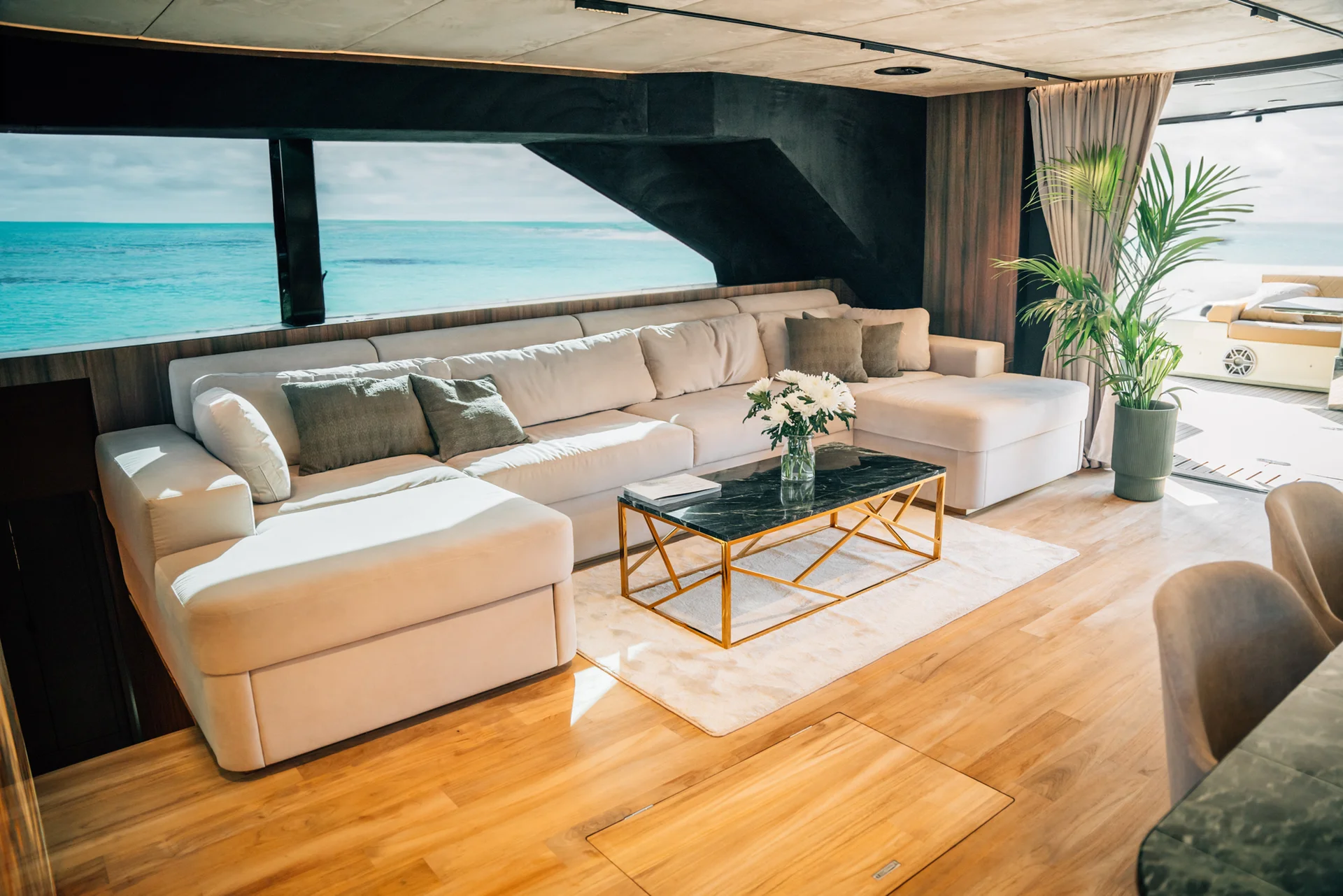
Width may give a multihull an appealing platform for dining and circulation. A monohull may create a different sort of intimacy and can use multiple levels to give people distinct places to settle. Neither result follows automatically from the category. The general arrangement and an actual walkthrough show where the table, sun, shade, swimming access and private corners really sit.
The MOON POWER 60, a motor catamaran in LYRA, and the Zeelander 6, a motor monohull, are examples of the two catalogue directions. They are not a matched recommendation or the centre of the comparison. Other yachts in each suitable segment may deliver the day's programme in markedly different ways.
At anchor, draft and access to the chosen bay can become material. Read the stated draft of the individual yacht, consider how and where it is loaded, and check the intended anchorage. The promise of a shallow-water lifestyle should rest on the actual boat and route, not an assumption that every multihull draws less water.
Returning home
End the comparison where ownership continues after guests leave. How easily can the yacht return to its berth? What needs cleaning, securing or preparing for the next outing? Where will the owner keep the equipment that made the day enjoyable? These ordinary steps influence how often a yacht is used, and frequency is part of the value the buyer expects from it.
A good comparison can hold two observations at once: one design may create a more compelling social platform, while another may fit the home base and preferred passage feeling more naturally. If motion is still uncertain, record that as something to test. If the berth is uncertain, ask the marina. The best decision does not require making one hull family sound inferior; it requires understanding which particular yacht makes the shared day feel like the owner's own.
LYRA's yacht-selection framework is built around that intended life. Comparing hull types through a complete day turns an abstract category into a vivid, testable ownership choice.