A family yacht has to accommodate more than a number of people. It has to support the way those people move, rest, eat, swim, spend time together and occasionally need space from one another.
This is why a large guest number does not automatically create a good family yacht. Capacity tells you how many people the yacht is presented as accommodating. Family suitability asks whether the experience can remain comfortable when the guests have different ages, routines and levels of confidence on the water.
In the LYRA catalogue, a useful search begins with two parameters: Family and Guest Capacity. The first identifies yachts presented as having a comfortable setup for family use. The second brings the expected group size into the decision. Together, they reduce a broad market to yachts that deserve a closer look through the reality of a particular family.
The Family parameter is about the use case
The Family tag sits within the Suitable For section of LYRA yacht pages. It signals that the yacht’s general setup has been assessed as relevant to time on board with family.
For a buyer, the tag is most useful at the beginning of the search. It allows family use to become a primary selection condition rather than a question added after a yacht has already attracted attention through design, speed or brand.
This matters because family plans often contain several experiences at once. Parents may want quiet time at anchor. Children may want immediate access to the water. Grandparents may value secure circulation and a comfortable route between cabins, salon and deck. Guests may need privacy. The family may also want enough shared space for meals and evenings together.
The tag brings potentially relevant yachts into view. The family’s own routines decide which ones remain.
Guest Capacity gives the tag a practical scale
The second parameter is the number of guests. It should reflect the people who will normally be aboard, not the largest gathering the owner can imagine.
A yacht chosen around an exceptional party can become unnecessarily complex for ordinary use. A yacht chosen around the smallest usual group may feel crowded when children bring friends or several generations travel together. The useful number is the realistic recurring group, with enough flexibility for the way the family actually entertains.
Day use and overnight use also need to be separated. A yacht may welcome a larger group during the day than it can accommodate privately overnight. Cabin configuration, bathroom access, crew space and storage become more important as time aboard extends. Guest Capacity can begin the comparison, while the arrangement of those guests requires a closer reading of the layout.
Examples from different parts of the catalogue
The range of family-tagged yachts shows why the two parameters need context.
The Prestige F4.9 is a 15.18-metre flybridge motor yacht presented for up to 12 guests. Its page combines Family, First Yacht and Single-Handed Operation, placing family use inside a relatively compact owner-operated scenario.
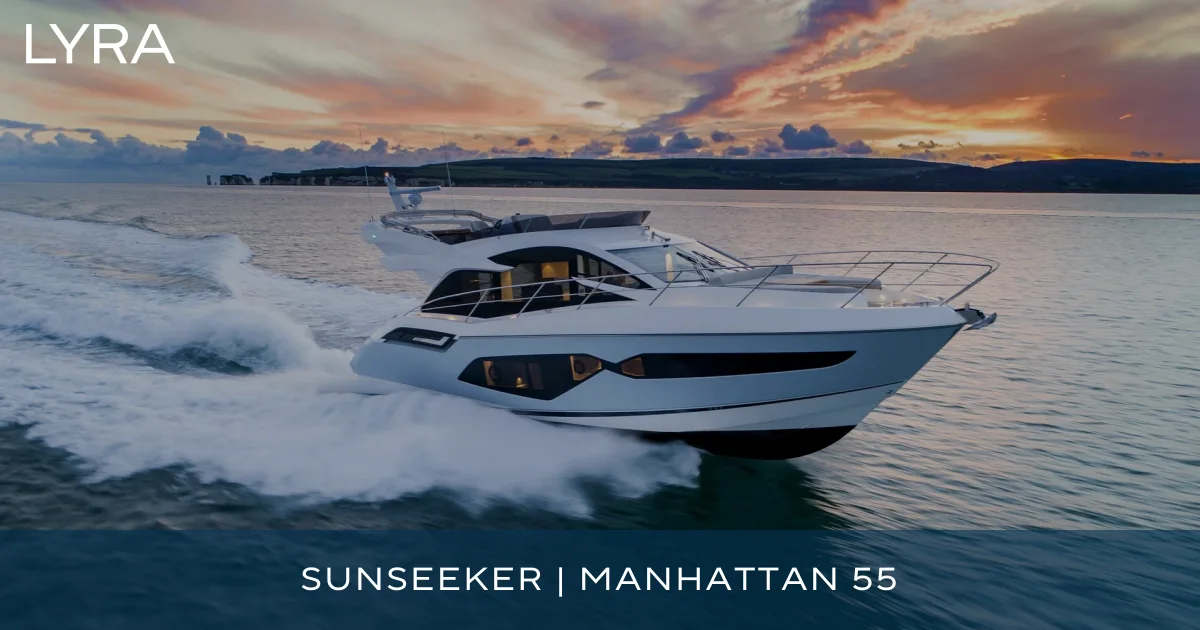
The Sunseeker Manhattan 55 is 17.21 metres and also presented for up to 12 guests. It carries Family and First Yacht, while its flybridge and cruising layout suggest a different balance of social space and longer stays.
The Hallberg-Rassy 57 brings family suitability into a 17.44-metre sailing yacht presented for up to 10 guests, with Travel and ocean-category capability also visible on its catalogue page.
These yachts are examples of different family-use directions. Once those directions are understood, the search should continue through the relevant segment as a whole rather than revolving around the named models.
A family layout should be read as a sequence
A deck plan becomes more useful when it is read through a typical day.
Begin with arrival. How easily can luggage, provisions and children move from the quay or tender onto the yacht? Where do wet shoes, towels and water toys go? Can the family reach the main living space without crossing a working area?
Then consider time under way. Where will people sit when the yacht is moving? Can adults maintain sightlines to younger children? Are there sheltered areas when the wind rises or the sun becomes strong? How do guests move between levels?
At anchor, the centre of activity often shifts toward the water. Access from the deck to the sea, the relationship between the swim platform and social spaces, and the storage of equipment can determine whether the afternoon feels effortless or constantly requires intervention.
Finally, look at the evening. The family may want one shared space after dinner and enough separation when different generations go to sleep. Noise, cabin access and the location of bathrooms become part of the ownership experience.
This sequence turns layout drawings into lived situations. It also exposes differences that a headline guest number cannot show.
A viewing should repeat the same sequence physically. Walk from the passerelle to the main deck with the bags and equipment of a normal trip in mind. Sit where the family would sit under way. Move from the cabins to the deck without using the route intended for a brochure photograph. Open the storage, find the handholds and look at the height changes between spaces. These observations are simple, but they reveal whether the yacht supports the family’s routine or asks the family to adapt continually to the yacht.
Privacy and supervision need to coexist
Family life on board contains a natural tension. People want to be together, while the yacht must also allow different routines.
Parents may want a cabin separated from children yet close enough for reassurance. Teenagers may value independence. Grandparents may need an easier route through the yacht. A professional crew, if present, needs working circulation that allows service to remain discreet without cutting through family spaces unnecessarily.
The most suitable balance depends on the family. A highly open plan can feel sociable during the day and exposed during a long stay. Greater separation can improve privacy while making supervision less immediate. Neither arrangement is universally superior.
This is where the catalogue parameters perform different jobs. Family and Guest Capacity identify the broad scenario. The detailed plan, a viewing and an informed discussion reveal whether that scenario works for this particular group.
Family suitability also changes the operating brief
The question reaches beyond accommodation. Frequent family use affects provisioning, cleaning, laundry, equipment, safety preparation, marina access and the support required before each trip.
A yacht that can be prepared quickly may encourage regular use during the season. A larger yacht may create more space and privacy while requiring a professional operating structure. The owner should decide which benefit matters more for the family’s normal rhythm.
The intended cruising area also shapes the answer. Warm-weather day use may prioritise shade, ventilation and direct water access. Cooler or less predictable conditions may place more value on protected interior circulation and comfortable enclosed spaces. Longer travel introduces storage, autonomy and the ability to sustain family routines away from the home marina.
These questions belong in the brief before the shortlist becomes emotionally fixed.
Use the catalogue to begin a family conversation
In the LYRA yacht-selection process, the strongest search begins with how the yacht will be used. For a family, that means describing people and routines rather than simply selecting a maximum capacity.
Choose the Family parameter in the catalogue, then set a Guest Capacity that reflects the usual group. Review the resulting yachts through day use, overnight stays, privacy, water access and the owner’s preferred operating model. The process should feel like an exploration of possible family life, not a technical checklist imposed from outside.
The result is a much clearer conversation with an adviser. Instead of asking whether a yacht is generally “family friendly,” the buyer can explain which spaces, relationships and routines must work. The adviser can then test those expectations against layouts, specifications, viewings and operational evidence.
The best family yacht becomes part of the family’s rhythm
Successful family use is visible in repetition. The yacht is easy enough to use that weekends happen. Children understand where things belong. Adults can relax without organising every minute. Shared spaces invite people together, and private spaces allow the day to have different rhythms.
The Family tag and Guest Capacity parameter provide a strong first reduction of the market. They identify yachts designed around the right broad scenario and the right scale of group. The final choice comes from examining how each yacht turns those parameters into movement, comfort and privacy.
A family-suitable yacht is ultimately the one that makes time together easier to enjoy.