An owner has a chain of destinations in mind, and one leg between them has few reliable places to refuel. That leg gives range an immediate purpose. It is no longer a distant specification on a yacht page; it determines which candidates deserve a closer look for the journey the owner wants to make.
For this scenario, two catalogue fields can frame the first pass: published range and cruising speed. The LYRA catalogue offers a range control, while model pages may show a cruising-speed value. The combination helps the buyer identify a relevant segment, but it does not yet prove that any specific yacht can make the passage with appropriate reserves. The actual route and technical evidence complete that test.
Find the longest useful leg
The decisive distance is not always the whole voyage. It may be the stretch between two dependable fuel points, including a sensible diversion or alternative arrival. The owner's route should be drawn before a minimum range is chosen. Otherwise the filter threshold can be a round number that sounds impressive but protects no real part of the itinerary.
The intended pace matters too. A yacht may be capable of covering a long distance at one speed while the owner prefers to travel differently. If reaching the next destination requires a passage style that the family would rarely enjoy, the advertised range is less relevant to the desired life aboard. A suitable yacht supports both the distance and a journey the owner wants to repeat.
This is why range can be a stronger early parameter for regional or exploratory cruising than for short trips around a well-served home port. The local owner may find greater first-pass value in handling, layout or ease of departure. The extended-route owner has a clearly defined leg that can be checked against every serious candidate.
Let the figure open the right questions
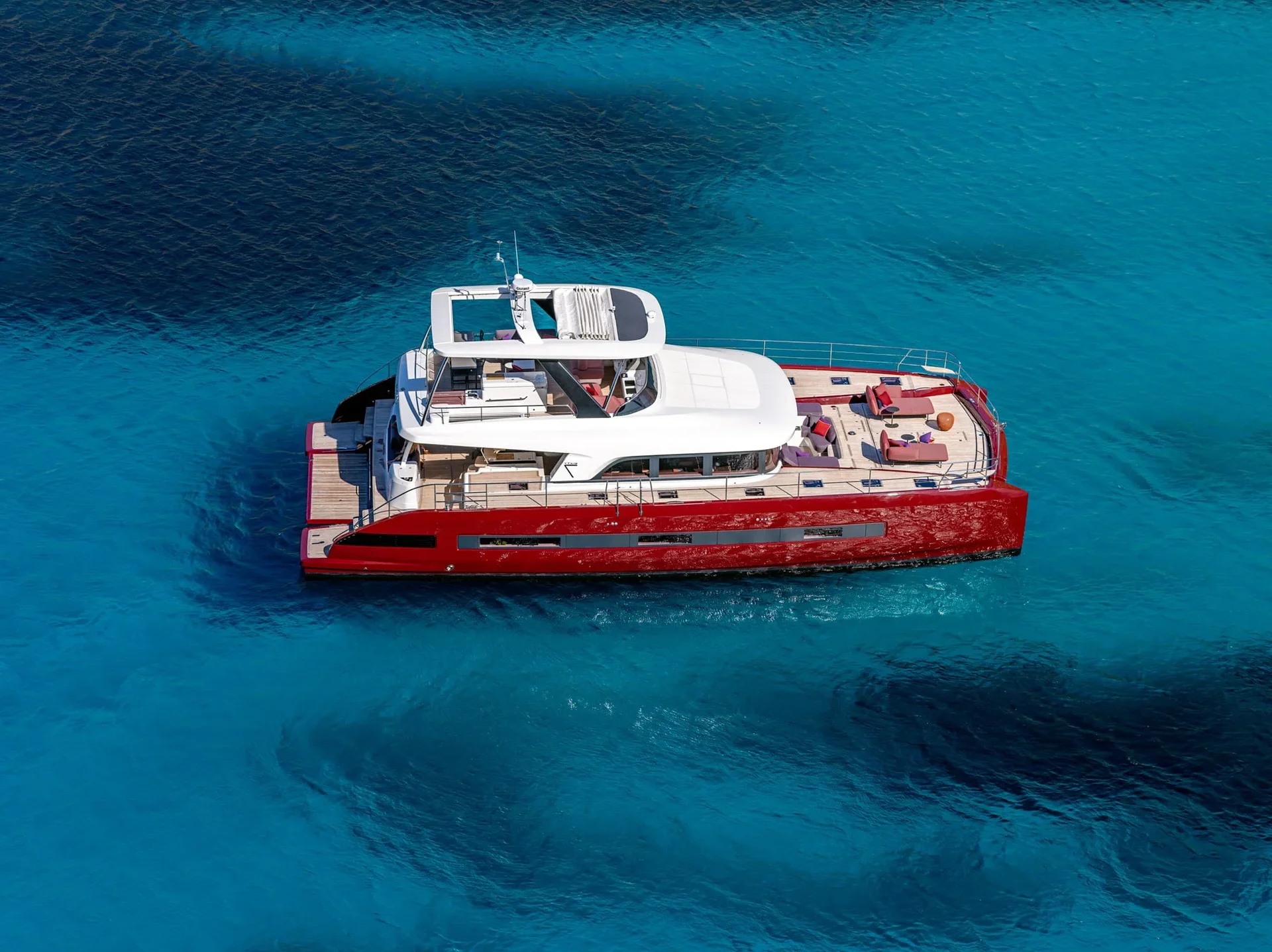
LYRA model pages provide examples of different stated ranges, including the Lagoon Sixty 7 and Canados OCEANIC 51 EXP. These are examples, not the article's shortlist or a suggestion that one should replace the other. Their different type and scale show why the buyer should first define an appropriate yacht segment and then examine range within it.
For each candidate, ask for the conditions behind its range figure: the exact engines, operating speed, carried load, fuel allowance and assumed reserve. A captain or technical adviser can then model the proposed leg with weather and alternative stops. If those conditions are not yet available, the candidate can remain of interest with a specific open question rather than being treated as proven or dismissed.
The process can reveal a pleasant surprise. A yacht whose headline range seems modest may be ideally placed for an itinerary with excellent refuelling stops. Another may make a more remote route feel natural. The correct choice depends on the actual geography and the way the owner wants to travel through it.
A threshold with a reason
A useful range requirement can be stated in plain language: this yacht should connect these two dependable points at a comfortable passage pace with an appropriate margin. The margin itself must be set for the exact voyage by qualified people; it is not an arbitrary percentage copied from an article. With that sentence, the owner can explore the market confidently while keeping the technical proof in its proper place.
LYRA's selection approach connects yacht specifications to intended experiences. Range deserves to lead when the owner's desired destinations make it a genuine boundary. The reward is a shortlist shaped by places the buyer is excited to see, not by a number chosen for its size alone.