A yacht's length is often the first number a buyer remembers. It appears on the card, in the conversation with a marina and in almost every comparison of market segments. That makes it useful, but it can also make the number seem more complete than it is. Length overall, usually shortened to LOA, establishes a yacht's physical scale. It does not tell you how much room you will enjoy, how naturally the yacht will move through a berth, or whether the arrangement suits the way you want to spend a day.
The LYRA catalogue lets a buyer explore size by class or metre range. Used well, that filter is a first reading of the market: it reveals the kinds of yachts available within a chosen envelope. Before treating the result as a shortlist, it helps to understand what the envelope describes.
One number, several practical consequences
LOA is an overall dimension, not an interior floor plan. A shipyard's current specification is the place to confirm exactly how the measurement is defined for a particular model and configuration. That detail matters when a marina quotes a maximum berth length or a yard plans a lift. For an owner, however, the more interesting question is what the length makes possible: a cockpit large enough for the usual group, cabins that suit real overnight guests, or a working deck that feels comfortable underway.
The same metre can be used in different ways. A yacht may devote more of its length to an open social area; another may use it for accommodation, tender handling or a longer foredeck. Two models with a similar LOA can therefore offer different daily experiences. Length identifies a scale at which to start looking. The general arrangement reveals how the designer spent it.
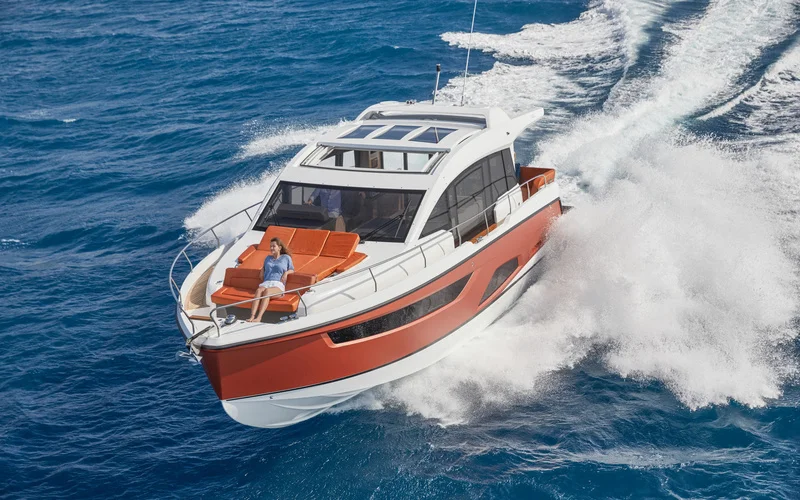
Beam gives that reading an immediate second dimension. It describes width, and width can change how spacious a saloon feels, how guests pass one another and what kind of berth the yacht needs. The Sealine C430, for example, is listed by LYRA at 13.55 metres long and 4.30 metres in beam. Those figures illustrate two dimensions of one yacht; they are not a recommendation or a substitute for seeing its actual layout. The same method applies to every model in the relevant size band.
Where the number becomes a real boundary
Sometimes length is an immediate operating constraint. A home berth may have a limit; a familiar harbour may favour a certain scale; the owner's preferred way of departing may involve handling the yacht with a small team. In those cases the maximum workable length belongs near the beginning of the search. It is better to discover the boundary while looking at a whole segment than after becoming attached to one attractive model.
In other cases length is a preference rather than a fixed rule. A family may expect a yacht of roughly a certain size because they want space for weekends. The useful question then is what the additional length actually buys them. If it provides a private cabin arrangement they will use often, the gain is tangible. If a slightly shorter yacht creates the same living experience with a berth closer to home, the owner's time on board may matter more than the nominal size difference.
This is why a length range works better than a single ideal figure at the exploratory stage. It leaves room for distinct yacht types and layouts while keeping the search within a scale that makes sense for the owner.
Read the whole yacht after filtering
The next step after setting a size range is to look at the yachts that remain as different interpretations of the same brief. Notice their beam and plan, but also where people board, sit, sleep and move to the water. The catalogue gives the buyer a disciplined entry point; the model page and current shipyard drawings explain the spaces behind it. A walk-through then tests whether those spaces feel as useful as they looked on paper.
The LYRA selection approach starts from the owner's lifestyle and goals. That is the right context for LOA. A number has a job when it helps shape the life the buyer wants: regular short outings, longer family stays, or a yacht that becomes a base for travel. It has much less value as an isolated badge of status.
The buying decision can remain ambitious and enjoyable while these distinctions are made. Knowing what LOA says, and what it leaves to be discovered, brings the search closer to the right yacht type. Length opens the door to a segment. The pleasure of ownership depends on what the yacht does with the space inside it.